


My friend Hector Herrera is not only a world class animator, he is also a gifted writer. In today’s guest post, he examines how our freedoms and democracy have been subverted and weaponized against us. The Constitution is not a suicide pact. He delivers an important message with the passion of a recently naturalized immigrant who escaped communism. You can find him on Substack at Friendly Fire and for comic relief, check out the videos we collaborated on: Elon’s struggle session, Kamala’s downfall, Trump’s Art of the Troll, and several more on the Meme News Network.
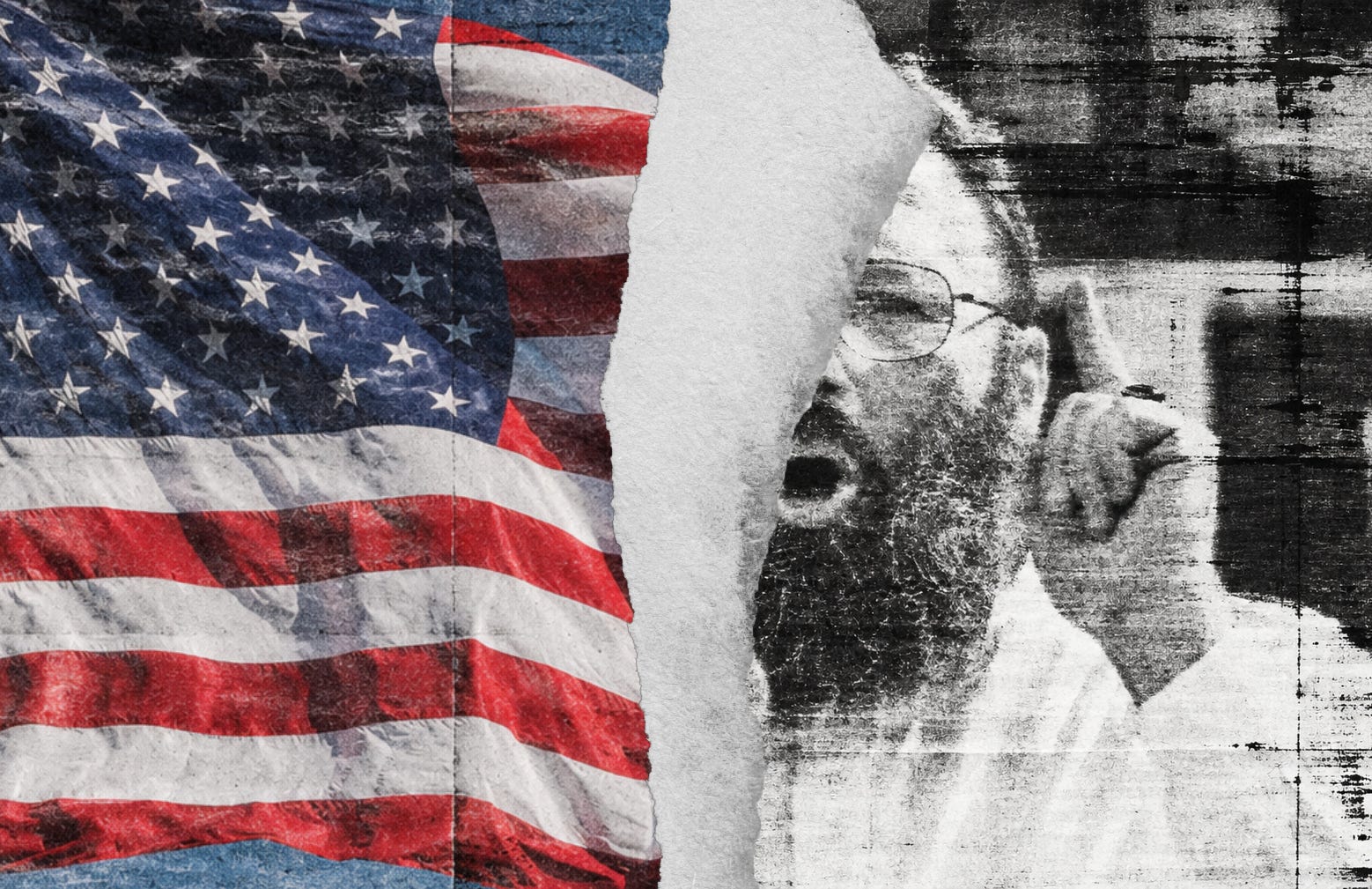
Years before ISIS existed, the Islamist cleric Omar Bakri Mohammed reportedly told journalist Patrick Goodenough something that seems to be willfully ignored by the vast majority of people in the West:
“We will use your democracy to destroy your democracy.”
In one sentence, Bakri identified the vulnerability at the heart of a free society.
Islamism treats Islam not merely as a religious belief, but as a governing political order. Some Islamist movements have been remarkably candid about their rejection of liberalism and their ambition to replace it.
Bakri’s remark is interesting precisely because it removes the comforting assumption of reciprocity. A western liberal hears “freedom of speech” and thinks of a principle. Someone like Bakri hears “freedom of speech” and thinks of a vulnerability in the enemy.
The western liberal assumes that we are all playing the same game, disagreeing perhaps viciously over policy, interpretation and the application of the rules, but accepting the basic constitutional framework within which our opponents retain their rights if we win.
The revolutionary may have no such intention. He can believe in our freedom instrumentally. He can use free speech without believing that free speech should survive his victory. He can use freedom of religion while believing apostasy should eventually be punished. He can use democratic elections while regarding democracy merely as the vehicle by which democracy can be brought to an end.
This is not a new problem. What may be new is our reluctance—or hubris—to admit that anyone, especially our enemies, thinks this way.
Communists and socialists continue to present liberal democracies with a similar dilemma. What should a free society do with people who use the freedoms of speech, association and political organization to advocate for systems that would radically transform, or in some cases abolish, the economic and political order that made those freedoms possible?
For citizens, the answer is comparatively straightforward: their right to advocate for a political system does not depend on whether the government approves of the system they advocate. The harder question—and the one that concerns me here—is what happens when the person advancing that project is not a citizen, but someone the country has chosen to admit.
If a movement tells you openly that it intends to use your freedoms to destroy the system that guarantees them, are you required to pretend that this intention is irrelevant, particularly when the people advancing that project are guests, students or permanent residents?
Should a free society extend the full protections of free speech and political liberty to non-citizens it has admitted who would use those freedoms to destroy the system that protects them?
The “God-Given” Dilemma
I am an immigrant. I did not inherit the right to live in the United States by accident of birth. I asked to come here because I wanted to join a country built around a particular constitutional bargain: that government exists to protect our God-given, unalienable rights against both foreign enemies and the government itself.
The American government was entitled to examine who I was, where I had lived, what I had done, whether I had committed crimes, whether I posed a security risk and whether I met the requirements America had established for permanent residency.
I never found this offensive. It was their country and I was asking to join it.
I have never been persuaded by the idea that immigration should be treated simply as another individual entitlement. Human beings possess rights. Countries possess borders. The first proposition does not erase the second.
I have been thinking about this because Mahmoud Khalil, the Columbia University activist whom the Trump administration has been trying to deport, is back in the news.
Khalil entered the United States on a student visa in 2022 and later sought permanent residency. He became one of the most prominent faces of the anti-Israel protest movement at Columbia. The Trump administration arrested him in March 2025 and sought his removal.
The administration said Khalil had distributed pro-Hamas propaganda. A lawsuit filed by American and Israeli plaintiffs accused Khalil and other Columbia activists of helping further Hamas’s propaganda objectives. Those allegations remain disputed, and Khalil has denied ties to Hamas.
The government subsequently accused him of failing to disclose, among other things, his work with UNRWA and previous employment with the British Embassy’s Syria office when he applied for permanent residency. That UNRWA connection drew added scrutiny after evidence emerged linking a number of the agency’s employees to Hamas and, in some cases, directly to the October 7 attacks. Khalil disputes the government’s broader case against him, and the immigration and constitutional litigation remains ongoing.
In a full-throated defense of not just Khalil’s, but everyone’s freedom of expression, Nico Perrino, Executive Vice President at the Foundation for Individual Rights and Expression (FIRE), has made one of the most effective arguments for free speech protection I’ve ever heard.
His argument is that if we truly believe, as the Declaration says, that human beings are endowed by their Creator with unalienable rights, and government exists to secure them, then Khalil’s free speech rights must be protected. His passport does not make him human and his green card does not create his conscience. The right precedes both.
It is a powerful argument and I agree with almost every premise. Still, I wonder whether something has gone wrong in the move from natural rights to immigration. Natural rights may be universal but political membership is not.
A man living in France possesses exactly the same natural right to speak his mind that I possess in Texas, even if that right is less robustly protected by his government, but he does not therefore possess a natural right to live in Texas.
America is not morally required to grant every person on Earth a visa because every person on Earth has natural rights. Admission into a political community is a different category. So is citizenship.
The difficult question lies between them.
Once the government admits someone, how much does his status matter?
Does a tourist have precisely the same claim to continued residence as a permanent resident?
Does a permanent resident stand differently from someone who arrived yesterday on a student visa?
At what point does a non-citizen’s presence become settled enough that deporting him for otherwise lawful conduct amounts to punishing him for his speech?
And if the person is using that speech in service of a movement that rejects the liberal order itself, does that change the calculation?
At what point do we switch from defending the law to defending the nation?
Jefferson’s Warning
That tension is hardly new. Thomas Jefferson put it this way in 1810:
“A strict observance of the written laws is doubtless one of the high duties of a good citizen: but it is not the highest. The laws of necessity, of self-preservation, of saving our country when in danger, are of higher obligation. To lose our country by a scrupulous adherence to written law, would be to lose the law itself, with life, liberty, property & all those who are enjoying them with us; thus absurdly sacrificing the end to the means.”
Jefferson’s appeal to “the laws of necessity” and national self-preservation presents a dangerous argument. History is littered with leaders who discovered that everything they wanted to do suddenly became “necessary.”
But a law cannot protect a country that no longer exists. A constitution cannot preserve liberty after the constitutional order sustaining that liberty has been destroyed. There must therefore be some point at which preserving the system takes priority over the ordinary rules of the system.
Perrino gives us the American principle at its most expansive: rights precede government and government exists to protect them.
Jefferson gives us the warning at the other edge: there may come a point when rigid adherence to the ordinary rules destroys the very system those rules were meant to preserve.
The question is where that point lies.
The Silent War
Even before the current hot conflict, the Islamic Republic of Iran has been shouting “Death to America” for decades.
Westerners occasionally respond to this by explaining that slogans are complicated. Sometimes they are. Political chants can have meanings beyond their literal translation, and not every Iranian shouting one has personally developed an invasion plan for Ohio.
Fair enough. But at some point it seems reasonable to take hostile regimes at least partly at their word.
Iran has not confined its antagonism toward the United States and its allies to rhetoric. Tehran has long supported armed proxy organizations, terrorism and other hostile activity across the Middle East. The distinction between inflammatory speech and state action is therefore not theoretical.
And yet the West often appears caught in a strange psychological trap.
Our enemies can say that they are engaged in a battle against us, they can finance groups engaged in that battle, they can celebrate violence committed in that battle. And we will still frequently insist that describing the conflict as a conflict is somehow an act of escalation on our part.
Perhaps this is because “war” has become too narrow a word.
We imagine Normandy, aircraft carriers and invading armies.
Our adversaries may be thinking about universities, propaganda, political pressure, economic leverage, espionage, institutional funding, social media bot farms, NGOs, demoralizing campaigns and ideological recruitment.
None of these things individually turns political disagreement into warfare. Nor should we use “war” so casually that every argument becomes a battlefield and every opponent an enemy. We shouldn’t always be at war with Eurasia.
Neither should we pretend that an activity becomes harmless merely because it also has a peaceful civilian use. The question is whether these institutions and tools are being used knowingly and strategically as part of a hostile political project.
The point is not to turn everything into war. The point is to recognize that war has never consisted only of shooting.
Our reluctance to call this broader struggle a war leads to our hesitation in considering some of its participants as enemy combatants—a category error that I suspect many of them do not make about themselves.
The term has a specific legal history. We should not casually turn political activists into prisoners of war by changing the vocabulary. But neither should vocabulary prevent us from recognizing a real phenomenon.
Propaganda, recruitment and political influence have always been part of warfare. States spend enormous sums attempting to shape the political behavior of their enemies without firing a shot.
Why should we assume that the only participant in a war worth noticing is the man holding the rifle? The harder question is whether our law can recognize participation in hostile ideological projects without criminalizing opinion.
The fact that real communist subversion existed did not make every accusation of communist sympathy legitimate. But the abuse of the accusation did not mean the underlying threat was imaginary.
What if your adversary understands himself to be participating in a centuries-long struggle against you while we insist on understanding him solely as another voice in the marketplace of ideas?
At what point does our tolerance cease being strength and become denial?
The Constitution is Not a Suicide Pact
All wars demand sacrifice. Taxes, rationing, military service and, mainly, the lives of our young. Could the sacrifice demanded by an ideological conflict be of a different kind than we’re used to?
Non-citizens the country has admitted already occupy a different constitutional position from citizens. They possess free-speech rights, but the government also retains powers over their admission and continued presence that it plainly does not possess over citizens.
The harder question is how far that distinction should extend. Should free-speech protections themselves be even narrower for non-citizens, especially when they knowingly align themselves with hostile foreign movements that would destroy those very rights?
“The Constitution is not a suicide pact.” That statement is attributed to Justice Robert H. Jackson and it seems to pierce at the heart of the conflict we’re facing.
But who decides when suicide is actually occurring?
The answer matters because governments are extremely good at moving from these people are dangerous to these people are adjacent to dangerous people.
The first category can be legitimate. The second has unjustly filled a great many prisons. There still must be somewhere in the system where Jefferson’s first principle survives.
The state cannot be required to admit an ideological enemy because his intentions have not yet become a felony. It cannot regard every organized effort to weaken the country as harmless until the participants obligingly cross a criminal threshold. It cannot be required to wait until the bomb explodes.
A country is not a courtroom. It has obligations to people who have not yet been harmed. It has obligations to future citizens. It has an obligation to survive.
But a system cannot survive indefinitely if everyone is taught that defending its boundaries is morally suspicious while exploiting those boundaries is morally neutral or virtuous. And that brings us back to the same question.
At what point do we cross the line from defending the law to defending the nation?
The Line Must Exist
I don’t yet know where the line is.
I’m increasingly convinced that there must be one, and equally convinced that allowing the government to draw it carelessly may be more dangerous than the problem the line is meant to solve.
But the difficulty of drawing a line does not prove that there is no distinction to be made. What we cannot safely do is pretend that because difficult cases exist, the categories themselves are imaginary.
And this returns me to Jefferson. The quote I cited earlier does not end where I ended it. Jefferson understood the danger of his own argument.
In the same letter in which he defended necessity and national self-preservation, he warned that officials could not simply invoke an emergency whenever laws became inconvenient. In ordinary circumstances, he wrote, “the example of overleaping the law is of greater evil than a strict adherence to its imperfect provisions.”
There is the whole problem. Jefferson gives the state permission to save itself. Then Jefferson warns us to fear the permission.
A republic has two obligations that cannot be cleanly separated. It must survive and it must remain a republic while surviving. Self-preservation without constitutional restraint eventually gives us the authoritarian state we claimed to be defending ourselves against.
Constitutional restraint without any instinct for self-preservation can become something just as fatal: a beautiful set of rules observed meticulously by the last generation destined to live under them. Both dangers are real.
And Bakri’s sentence brings us back to the problem in its simplest form:
“We will use your democracy to destroy your democracy.”
The answer cannot be to abandon democracy first. But neither can it be to pretend that no one intends to take his strategy seriously. The argument between those dangers is not an inconvenience standing in the way of the American system. It may be one of the things keeping that system alive.
I'm about as close as one can come to being a free-speech absolutist, and recognize the dilemma here as a difficult one. It seems clear, however, that most of our republics in the West, including the US, have gone way too far in their concern for the rights of noncitizens, including on speech. Domestic Hamas supporters may be allowed to speak their toxic inanities. Those here on a visa should be expelled. In short: "One law for the citizen, one for the non-citizen."
This goes too for expulsion of illegals. The attempt to thwart the Trump administration's move to get rid of Albrego Garcia--it has no standing with me personally. Too bad for Garcia. He's here illegally, he didn't leave, now we remove him to wherever suits our convenience. Swiftly, if we want. Cry me a river.
This is going to be necessary across the West if anything like our republics are to survive. We should have gotten to it many years ago. I'm down with: "Oh, you are from X country. We are removing everyone from X country." "But why?" "Because we fucking want to."
Bukele is right about France. A beautiful country, if you can keep it, and it looks like you can't. Remove all those without papers, en masse, starting now. Crack down on those who have citizen status but insist on making trouble. For instance: A mob starting fires, *any mob* doing so, deserves lead. Of course the French have neither the security resources nor the stomach for it. Which is too bad for them. They're very likely toast if they don't reassess.
In the US, I envision three categories:
1) citizens, whose rights must be protected;
2) visa-holders, whose free speech rights are respected to some degree, but who can lose their right to stay if they advocate for enemies of the US;
3) illegals, whose free speech rights exist and we may entertain, if we so choose, but who we may remove for whatever reason we like at whatever time, and swiftly.
Such categorization is dicey in terms of our constitution, and yes, it's somewhat ugly. What is uglier is the alternative.
This, I submit, is the moderate option.
Banger.
The Trojan Horsing of ourselves was to deliberately put us in this untenable situation.
What are we expected to do when the "Visgoths, Vandals and Huns" are already inside the gates?